
Lonely in a crowded world: what isolation does to your mind and how to reconnect
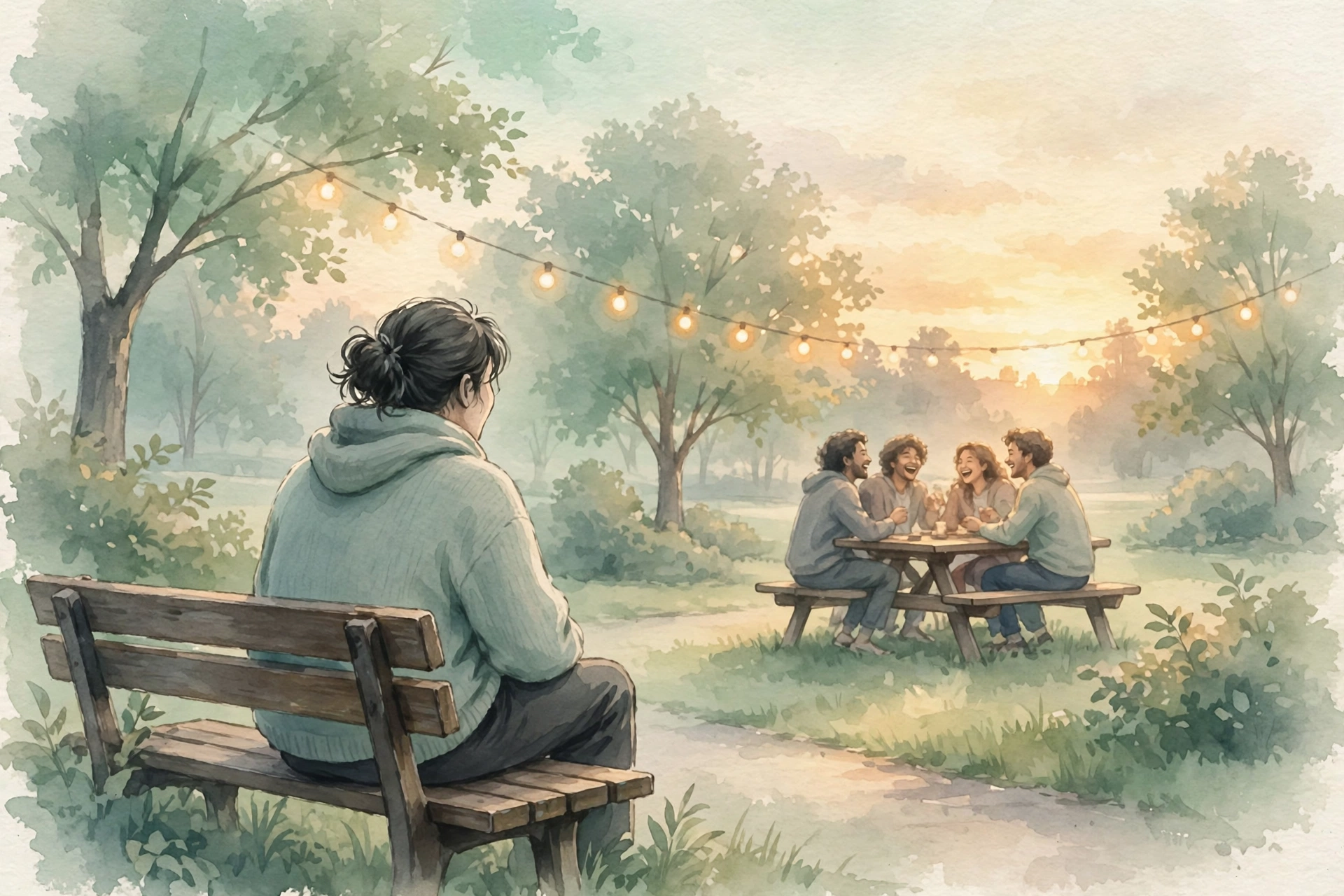
You can be surrounded by people all day and still feel lonely at night. You can have a full calendar, a group chat that never stops, a partner asleep next to you, and still carry a quiet ache that none of it quite reaches you. If that sounds familiar, you should know two things. First, you are far from alone in it. Second, loneliness is not a character flaw. It is a signal, and it is one your brain takes very seriously.
Loneliness is not about the number of people around you. It is the gap between the connection you need and the connection you feel. A person with two close friends can feel deeply connected, while a person with two hundred contacts can feel invisible. That distinction matters, because it changes what actually helps. More people is not always the answer. Better connection is.
The scale of the effect surprised even the researchers who found it. In 2010, a team at Brigham Young University pooled 148 studies covering more than 300,000 people followed for an average of seven and a half years. People with stronger social relationships had about a 50 percent better likelihood of survival than those with weaker ones, and the effect held across ages, starting health, and causes of death. The authors concluded that social connection belongs on the same list as smoking, diet, and exercise. Connection is not a soft extra in life. It is closer to a vital sign.
The link to mental health runs just as deep. In a study of nearly 5,000 American adults followed over ten years, researchers found that the quality of a persons relationships predicted depression a decade later. Those with the poorest quality relationships, strained and unsupportive rather than warm and reliable, had more than double the risk of a major depressive episode: 14.0 percent versus 6.7 percent. Poor quality with a spouse or partner and with family each raised the risk on its own. And here is the part that reshapes the advice: being alone, or simply having fewer contacts, did not predict depression. It is not how many people you know. It is whether the ones closest to you feel safe and steady.
There is a reason loneliness cuts so deep. Your brain treats disconnection as a threat. When you feel lonely, your mind starts scanning social situations for rejection the way it would scan a dark street for danger. You read a neutral face as cold. You reread a short text as proof someone is pulling away. You expect the invitation that never comes. And to protect yourself, you pull back first. That withdrawal then confirms the story: fewer invitations, less contact, more evidence that you do not belong. Loneliness becomes a loop that seals itself, and the lonelier you feel, the harder the loop is to see from the inside.
This is also why the usual advice, just get out more, so often falls flat. In 2011, researchers published a meta analysis of interventions designed to reduce loneliness, and the most effective ones did not simply add more social events to a persons calendar. They helped people rework how they read social situations, the expecting rejection part. The lonely brain had learned to assume the worst, and that assumption was what needed treatment. More parties never fixed a story the mind kept telling.
So what does work, in real life? Think small and repeated, not big and rare. A weekly walk with one friend does more than a crowded party once a month, because your nervous system learns safety from rhythm, not from volume. Choose one relationship and invest there. Pick the person who feels steadiest, not the one who feels most impressive. Tell the truth to someone safe about how you have been feeling, because loneliness thrives on performance and shrinks when it is named. Consider service or volunteering, where your presence matters to someone else, because being needed is one of the fastest routes out of feeling invisible. And practice noticing the moments when connection does land, the short laugh with a coworker, the text that made you smile, because a threat scanning brain needs to be taught that warmth is still happening.
A few cautions. If loneliness travels with low mood, loss of interest in things you used to enjoy, or sleep and appetite changes most days for two weeks or more, that deserves real care, not just tips. Depression and loneliness feed each other, and treating one often loosens the other. Tell your prescriber or therapist what is happening socially, not just what is happening chemically. Relationships are part of the clinical picture.
Loneliness is painful, but it is also honest. It is your mind telling you that you were built for connection and that something in your life is not meeting that need. That signal is not an accusation. It is a direction. And the research is clear on the most hopeful part: it is the quality of connection that protects you, which means you do not need a hundred friends. You need a few good ones, and a brain willing to let them in.
Anthony
Sources: Holt Lunstad J, Smith TB, Layton JB, PLoS Medicine (2010), social relationships and mortality risk, a meta analytic review of 148 studies, PMID 20668659. Teo AR, Choi H, Valenstein M, PLoS One (2013), social relationships and depression, ten year follow up from a nationally representative study, e62396. Masi CM et al., Personality and Social Psychology Review (2011), a meta analysis of interventions to reduce loneliness, PMID 20716644.