
Why your mind gets loudest at night: bedtime anxiety, the tired brain, and how to quiet it
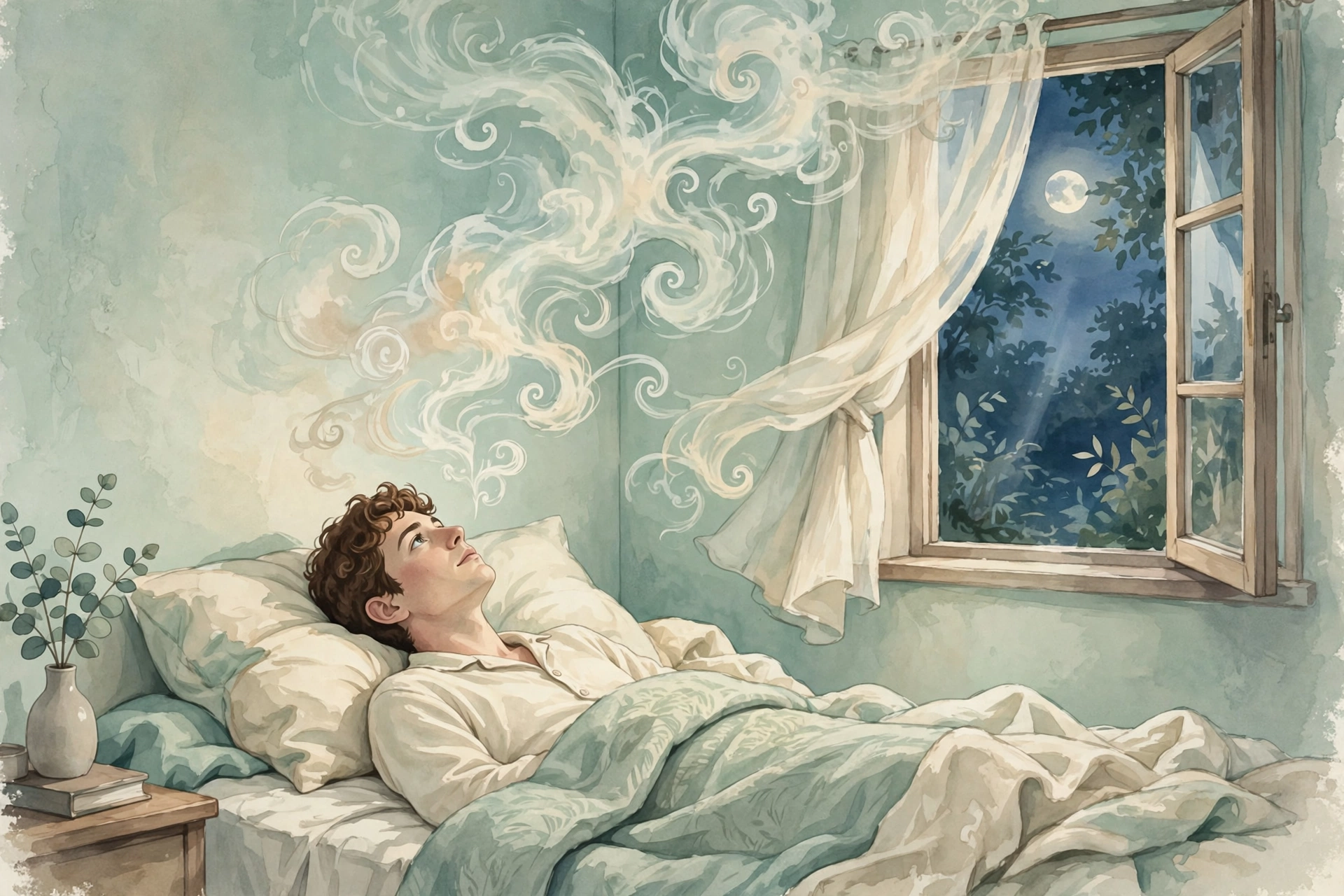
You can handle almost anything at 2 in the afternoon. The same worry at 2 in the morning feels entirely different. The deadline, the conversation that went sideways, the ache in your body you ignored all day. In the dark, every one of them grows louder, closer, harder to put down. If your brain seems to save its worst material for bedtime, you are not imagining it. There is a real reason your mind gets loud at night, and understanding it is the first step to turning the volume down.
In 2002, the sleep researcher Allison Harvey described a cycle that will feel familiar to anyone who has stared at the ceiling at 1 a.m. It starts with worry in the hours before bed. Not just worry about life, but worry about sleep itself. How long this is taking. What tomorrow will feel like. Whether this means something is wrong. That worry keeps the body in a low grade state of alert. The alert state makes sleep harder to reach, which confirms the worry, which makes the next night harder still. Harvey argued that this loop, more than any single bad night, is what turns occasional restless nights into chronic insomnia. The bed becomes a place of effort instead of rest.
The cruel part is that a tired brain is worse at handling exactly these thoughts. In 2007, researchers at UC Berkeley scanned the brains of people who had been kept awake all night and then showed them increasingly upsetting images. In the sleep deprived group, the amygdala, the brain's alarm center, reacted about 60 percent more strongly than in rested participants. At the same time, the connection between the amygdala and the prefrontal cortex, the part that talks the alarm back down, went quiet. A tired brain does not just feel worse. It is measurably worse at calming itself. The 2 a.m. spiral is not a character flaw. It is what happens when an overactive alarm meets an exhausted brake.
This matters because sleepless nights are not just unpleasant. They are one of the strongest predictors we have of where your mental health is headed. In 2011, researchers pooled the longitudinal studies on insomnia and depression and found that people with insomnia were about twice as likely to develop depression later on. A 2019 review went further. Across thirteen studies, insomnia predicted not only depression but also anxiety, alcohol problems, and psychosis. The risk was largest for anxiety, at more than three times the odds. Sleep is not a luxury your mental health can do without. It is one of the load bearing walls.
Here is the hopeful part. The same research that connects sleep and mood also shows the loop can be interrupted. Cognitive behavioral therapy for insomnia, often called CBTi, works directly on the cycle Harvey described. It teaches you to get out of bed when you are awake so the bed stops pairing with worry, to hold a consistent wake time, and to challenge the beliefs that keep the alarm ringing. It is the first line treatment for chronic insomnia, and it works without medication.
If tonight is a loud night, a few things help more than sheer effort. Effort is the enemy here, because trying harder to sleep is itself a form of alertness. First, give worry a different address. Set aside ten minutes earlier in the evening to write down what is on your mind and one small next step for each item, then close the notebook. Second, if you are awake for more than about twenty minutes, get up. Go somewhere dim, do something boring, and return only when you feel sleepy. Your bed should mean sleep, not struggle. Third, keep one steady wake time, even on weekends. It is the single most powerful anchor for your body clock. And put the phone across the room. The scroll is engineered to keep your alarm center lit.
If the loud nights are the rule rather than the exception, that is worth bringing to a visit. Chronic insomnia responds to real treatment, and treating it often lifts mood and anxiety along with it. You do not have to white knuckle your way through the dark. The night does not have to be the loudest part of your day.
Anthony
Sources: Harvey AG, Behav Res Ther (2002), a cognitive model of insomnia, PMID 12186352. Yoo SS, Gujar N, Hu P, Jolesz FA, Walker MP, Curr Biol (2007), the human emotional brain without sleep, a prefrontal amygdala disconnect, PMID 17909163. Baglioni C et al., J Affect Disord (2011), insomnia as a predictor of depression, a meta analytic evaluation of longitudinal epidemiological studies, PMID 21300408. Hertenstein E et al., Sleep Med Rev (2019), insomnia as a predictor of mental disorders, a systematic review and meta analysis, PMID 30537570.